What to Do After a Work Injury – Treatment, Rights, and Real-Life Examples
A workplace accident can happen to anyone, regardless of the industry or job position. What matters most is knowing what to do after a work injury, understanding your rights, and taking the right steps to recover properly.
Unfortunately, many employees are unfamiliar with Workers’ Compensation procedures, and as a result, treatment after a work injury often gets delayed for weeks or even months.
Today, we speak with PDR Physical Therapy’s licensed physical therapist, Ewa Kręcisz. In this interview, she discusses what to do after a work injury, how the Workers’ Comp process works, and why proper rehabilitation is essential for a full recovery.
What to do after a work injury – do employees actually know the steps?
Ewa: In my experience, most employees don’t actually know what qualifies as a work injury. When someone falls off a ladder at work – the situation is clear, and everyone understands it’s a workplace accident. But a work-related injury can also be the result of repetitive strain or daily physical duties.
One example is a patient who worked in a large hotel, making dozens of beds every day. She lifted heavy comforters and sheets over and over again until shoulder pain became unbearable. The doctor ultimately confirmed that this was a work-related injury caused by the physical demands of her job and advised her to report it under Workers’ Compensation.
What happens when no one helps after a work injury?
Unfortunately, we often see patients who struggle to navigate the Workers’ Comp system. For example, a striking case is the story of Maria. While at work, a large box full of metal screws fell directly onto her shoulder. As a result, the damage was severe and required surgery to reattach a torn muscle.
In theory, everything should have gone smoothly. It was a clear workplace accident, and the injury was serious enough to require immediate treatment and rehabilitation after a work injury. However, things did not go as expected. Maria waited months for her Workers’ Comp approvals. She didn’t speak English, didn’t understand the procedures, and her employer was not willing to help. Because of this, she spent weeks at home, waiting for someone to make a decision.
Eventually, when she found us, she was desperate for both medical care and guidance. Her previous physical therapy sessions brought almost no progress. Moreover, long gaps between treatments only made her condition worse. At the same time, rehabilitation after a workplace injury needs to be continuous and well-planned to prevent stiffness, scar tissue, and chronic pain.
Do you have to use the doctor or clinic suggested by your employer?
Absolutely not. Many employees simply don’t know this. Under Workers’ Comp, you have the right to choose your own doctor and your own physical therapy clinic, regardless of what your employer or insurance company suggests. And this choice often determines the quality of recovery.
Every employee has the right to:
- choose their own treating physician,
- select a physical therapy clinic that feels right for them,
- request a second medical opinion if progress is limited,
- change clinics if the current one is not helping.
The quality of rehabilitation after a workplace accident determines whether the employee can safely return to work or continue struggling with chronic pain and limited mobility. That’s why choosing a clinic that truly specializes in work-related injuries is so important.
Does PDR assist with Workers’ Comp paperwork and communication?
Yes — and patients appreciate this enormously. At PDR, we don’t just focus on the physical rehabilitation after a work injury. We also help patients navigate the entire Workers’ Comp process. Our staff guides them step by step, from the first doctor visit to the completion of therapy. Moreover, we contact the physician and the insurance adjuster to obtain approvals for therapy and to ensure authorizations are extended when needed.
For patients who do not speak English, this support is especially valuable. They can focus on healing instead of worrying about complicated communication with adjusters and employers.
What does physical therapy after a workplace injury look like?
It always depends on the specific injury and the type of work the patient needs to return to. For instance, rehabilitation for someone who underwent shoulder surgery will look very different from therapy for someone who strained their lower back or knee. Nevertheless, in most cases, treatment after a workplace accident follows several key stages.
1. Pre-operative physical therapy (if surgery is required)
If the patient comes to us before surgery, we prepare them for the procedure. During this phase, we focus on mobility, strength, posture, breathing, and functional movement patterns. As a result, the body is better prepared for the surgical stress, which in turn improves outcomes and speeds up recovery.
2. Post-operative or post-injury rehabilitation
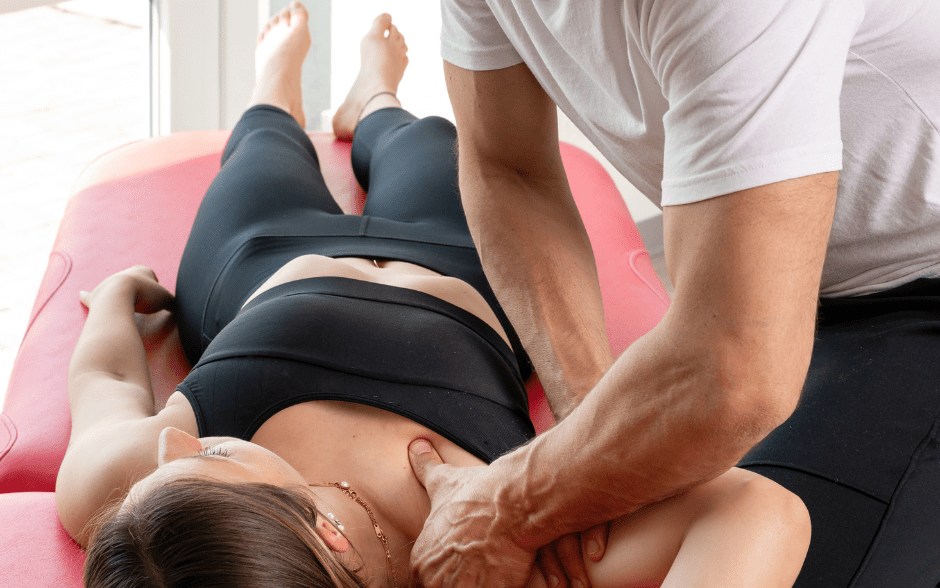
The next stage is post-injury physical therapy. At PDR, we rely heavily on manual therapy. One of the key methods we use is Fascial Counterstrain, which offers excellent results for work-related injuries. It helps reduce inflammation, improve circulation, and decrease pain. It can also prevent adhesions and scar tissue formation.
We also incorporate therapeutic modalities, including ultrasound, laser therapy, and electrical stimulation. A well-structured program helps patients gradually regain mobility, strength, and confidence.
3. Work Conditioning – preparing the patient to return to the job
The final phase is Work Conditioning, an intensive functional training program designed to simulate real job tasks. Under a therapist’s supervision, the patient practices lifting, bending, walking, carrying, pushing, pulling, and working with resistance. It is wort to know, that this part of the treatment usually takes several hours per day.
This allows us to determine whether the patient is truly ready to return to work. Only after completing this phase can both the doctor and therapist confidently confirm that the patient can safely resume their job duties.
Had a workplace accident or work-related injury and are not sure what to do after a work injury?
Need rehabilitation after a work injury or help navigating your Workers’ Comp case? At PD Rehab, we guide patients from day one all the way to full recovery. Learn more about our treatment for work-related injuries: Physical Therapy for Work Injury.
Want to schedule an appointment? Contact us